
Uzo Egonu, Will Knowledge Safeguard Freedom 2 1985 (c) Estate of Uzo Egonu. Tiana and Vikram Chellaram
As a Nigerian born and raised, and later educated in the UK, I approached the Nigerian Modernism exhibition at Tate Modern with both familiarity and curiosity. That dual perspective is precisely why I left feeling—unexpectedly—underwhelmed.
This feeling does not stem from the quality of the work itself. Nigerian artists are among the most inventive in the world. Across generations and regions, Nigerian art has always carried immense visual intelligence, cultural depth, and emotional force. The issue here is not talent. It is representation.
J.D. Okhai Ojeikere, Untitled (Mkpuk Eba) 1974, printed 2012. © reserved. Tate.
Room after room, the exhibition felt limiting in what it communicated to an audience largely unfamiliar with Nigeria. What was presented felt like a partial truth. A familiar one. Nigeria rendered again through a narrow cultural lens.
The emphasis echoed a long-standing shorthand: Yoruba, Hausa, Igbo. While these identities are vital, they are not the sum of us. Nigeria is a nation of over 370 ethnic groups, climates, histories, and lived realities. Where, then, was the South?
Where were the waterscapes of the creeks and deltas, the palm oil and banana trees, the dense greenery shaped by heavy rainfall and heat? Where were the watercolours and mixed-media works born of Southern Nigeria’s geography? Where was the visual language of crude oil refineries, oil spills, gas flares—images inseparable from the Niger Delta experience and modern Nigerian life?
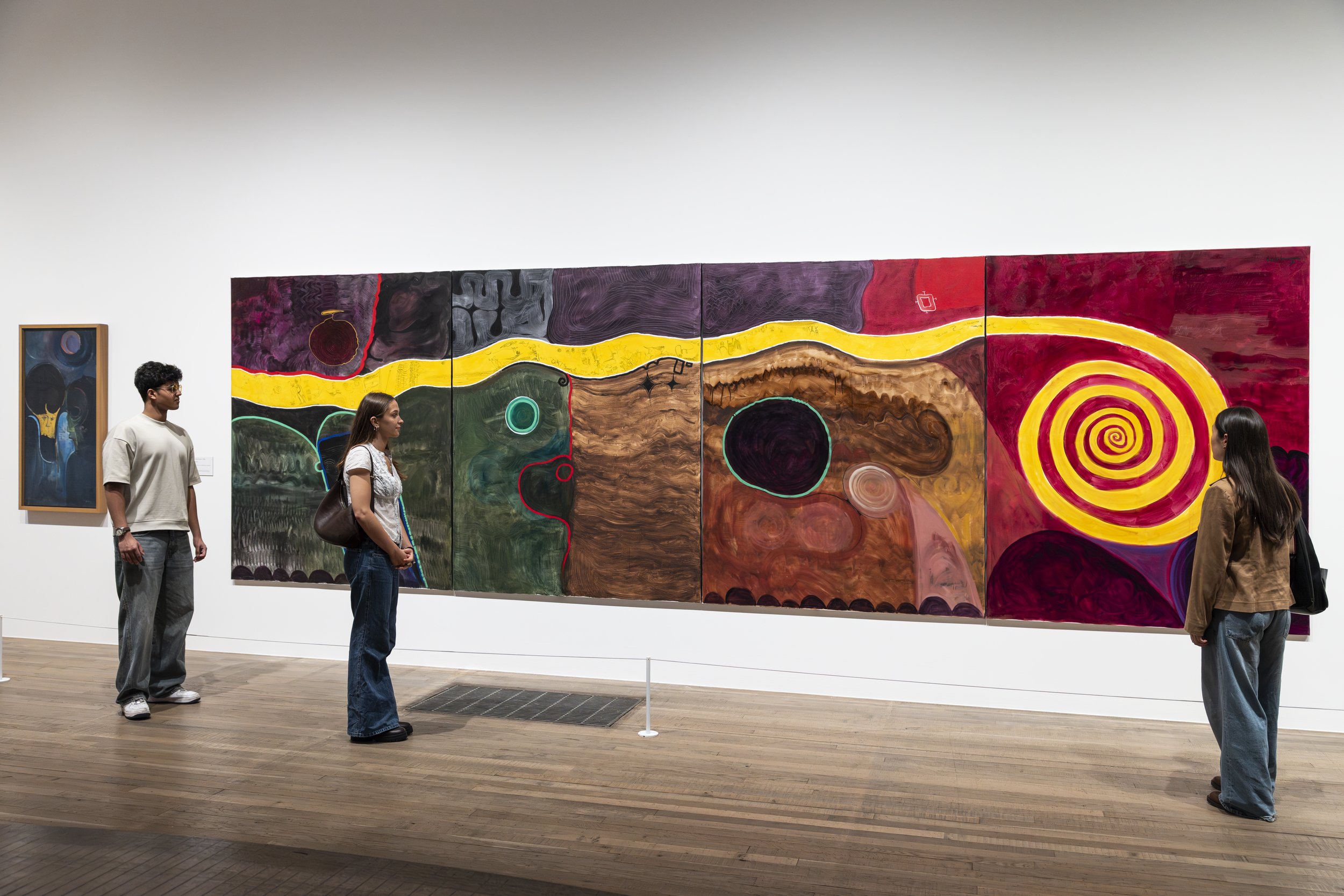
Installation Photography, Nigerian Modernism, Tate Modern, 8 October 2025 - 10 May 2026 © Tate Photography (Jai Monaghan)
I accept that my response is, in part, shaped by where I come from. To grow up Southern Nigerian is to carry that history and its absences. Still, that absence matters—especially in a national exhibition positioned for global consumption.
I commend the intention and effort behind Nigerian Modernism, and I celebrate every artist whose work was shown. Yet I left feeling the exhibition may serve the foreign viewer better than the Nigerian one. However, it risks reinforcing a commercialised, simplified version of Nigeria—one many of us no longer recognise ourselves in.
If we are to see ourselves reflected in the waters of history, we must be shown in full. We are here. All of us.
Going forward, if we are to communicate Nigeria, let us communicate all of it—the beauty, the tension, the regions, the climates, the contradictions. There is much to love, and much to question. Both deserve space.


Experience the Nigerian Modernism exhibition until 10 May 2026. More details on Tate Modern